Today, the EPJ Data Science journal published our article “Personalisation and profiling using algorithms and not-so-popular Colombian music: goal-directed mechanisms in music emotion recognition”. The main goal of this study led Juan Sebastián Gómez-Cañón (Universitat Pompeu Fabra / Stanford University) and Thomas Magnus Lennie (Durham University / American University in Bulgaria), with Tuomas Eerola (Durham University), Estefanía Cano (Songquito), Perfecto Herrera (Universitat Pompeu Fabra) and Emilia Gómez (Universitat Pompeu Fabra, Barcelona / Joint Research Centre) was to examine how personalized Music Emotion Recognition systems can enable sensitive profiling when applied to musically induced emotions in politically charged contexts.
Abstract:
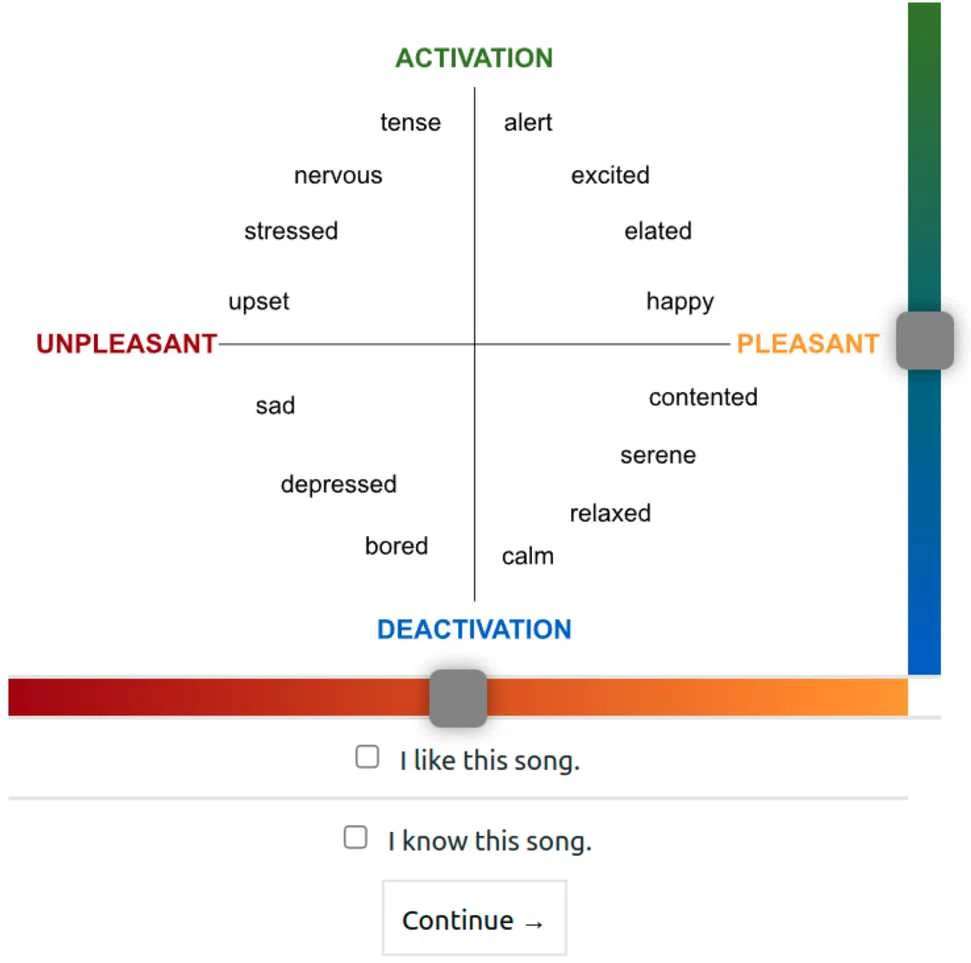
This work investigates how personalised Music Emotion Recognition (MER) systems may lead to sensitive profiling when applied to musically induced emotions in politically charged contexts. We focus on traditional Colombian music with explicit political content, including (1) vallenatos and social songs aligned with the left-wing guerrilla Fuerzas Armadas Revolucionarias de Colombia (FARC), and (2) corridos linked to sympathisers of the right-wing paramilitary group Autodefensas Unidas de Colombia (AUC). Using data from 49 participants with diverse political leanings, we train personalised machine learning models to predict induced emotional responses – particularly negative emotions. Our findings reveal that political identity plays a significant role in shaping emotional experiences of music with explicit political content, and that emotion recognition models can capture this variation to a certain extent. These results raise critical concerns about the potential misuse of emotion recognition technologies. What is often framed as a tool for wellbeing and emotional regulation could, in politically sensitive contexts, be repurposed for user profiling. This work highlights the ethical risks of deploying AI-driven emotion analysis without safeguards, particularly among populations that are politically or socially vulnerable. We argue that subjective emotional responses may constitute sensitive personal data, and that failing to account for their sociopolitical context could amplify harm and exclusion.
 Pablo Aragón